
Indian companies are increasing corporate video investment because video has quietly become the default way businesses communicate – both internally and with B2B buyers – at the same time that production has split into a faster, leaner tier alongside the traditional premium one. Hybrid work pushed training and leadership communication onto video out of necessity. B2B buyers increasingly expect to watch something before they’ll take a sales call. And AI-assisted tools have made video production more accessible to teams that previously found it out of reach.
This is a different story from the rising TV and OTT ad spend we covered in a previous piece – that’s about paid broadcast reach. This is about corporate and B2B video specifically: training, investor communication, sales enablement, and culture. Here’s what’s actually driving the shift, and what it means as you plan your own video approach.
Not sure where your next corporate video fits into this shift? Get in touch and we’ll help you think it through.
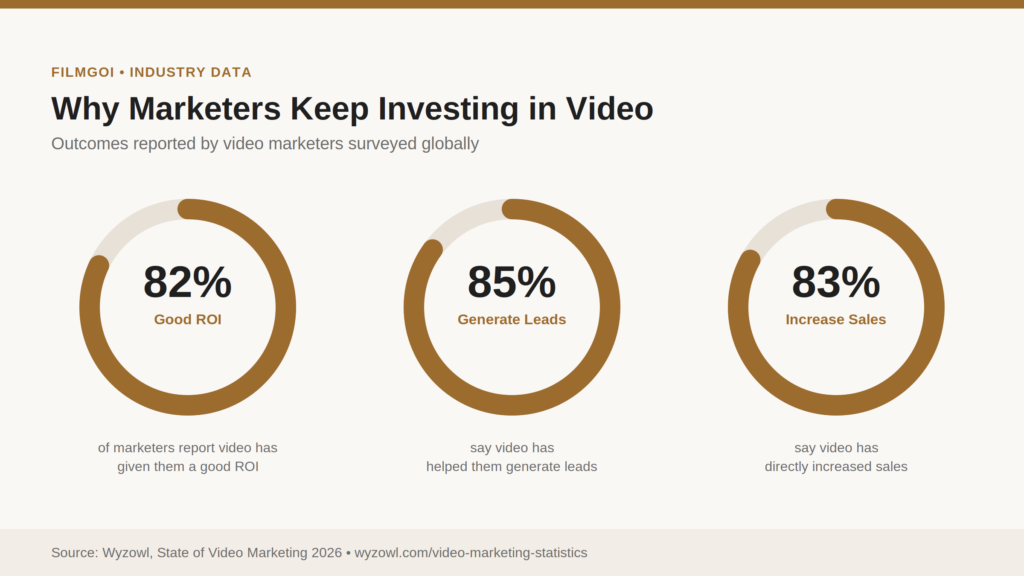
Video adoption and reported ROI remain high globally, and Indian manufacturing specifically has been named as a sector increasing investment in corporate and safety video.
Metric | Data Point | Source |
Marketers reporting good ROI from video | 82% | |
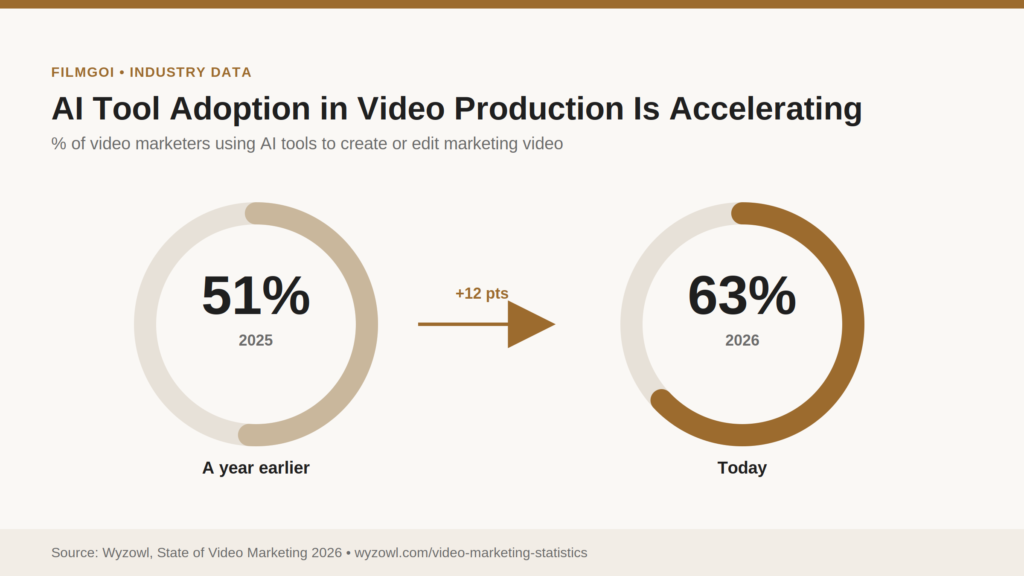
Video marketers using AI tools in production | 63% (up from 51% the year before) | Wyzowl, State of Video Marketing 2026 |
Marketers who say video has helped generate leads | 85% | Wyzowl, State of Video Marketing 2026 |
Marketers who say video has directly increased sales | 83% | Wyzowl, State of Video Marketing 2026 |
Ideal video length (30 sec–2 min) cited as most effective | 71% of marketers | Wyzowl, State of Video Marketing 2026 |
Indian manufacturing sector investing in corporate and safety video | Named trend | SiliconIndia |
Worth flagging honestly: the figures above are global, not India-specific – there isn’t yet a widely available, methodologically transparent survey of Indian corporate video spend specifically that we could point to with confidence. What we can point to with confidence is the direction: global adoption and reported ROI are both high and holding, and India’s manufacturing sector has been named directly, in named industry coverage, as a sector actively increasing this kind of investment.
Hybrid work, B2B buyer expectations, AI-assisted production, and video-first investor communication are the four factors driving the shift.
Hybrid work made video the default internal communication tool. Leadership updates, onboarding, and training increasingly move to video because it scales across dispersed teams and multiple office locations in a way live meetings and long email threads simply don’t. A recorded training module gets watched consistently across every location; a live session doesn’t.
B2B buyers increasingly expect video before they’ll engage. The customer side of Wyzowl’s 2026 data backs this up directly: 96% of people say they’ve watched an explainer video to learn about a product or service, and 85% say a video has convinced them to buy something. For B2B specifically, that’s pushing budgets toward explainer, demo, and testimonial video earlier in the sales funnel, not just at the closing stage.
AI-assisted production has made video more accessible. The jump in AI tool usage among video marketers – from 51% to 63% in a single year, per Wyzowl’s 2026 data – reflects a genuine shift in who can now produce video, not just how much the largest companies spend. Worth being precise here: AI is mainly handling concepting, previsualization, and lower-stakes variants. Flagship, brand-critical films still rely on traditional production and human direction – this is a bifurcation of the market, not a wholesale replacement.
Investor and stakeholder communication has gone video-first. Company profile films, investor updates, and CSR/impact videos are increasingly standard for fundraising and stakeholder reporting rather than optional extras. This is especially visible in manufacturing and industrial sectors, where plant walkthroughs and safety videos have become a practical way to show remote investors and clients what operations actually look like without flying anyone in.
Manufacturing and industrial companies in India have been directly named as investing in corporate and safety video, driven largely by compliance and training needs.
Manufacturing and industrial companies are investing specifically in corporate and safety video, driven by compliance requirements, training needs, and the need to give remote investors and clients transparency into operations they can’t easily visit in person. Beyond manufacturing, sectors with longer B2B sales cycles – where a buyer typically self-educates before ever speaking to sales – are the ones where video adoption tends to show up earliest, consistent with the buyer-behavior shift described above.
Curious how this shift applies to your sector specifically? Talk to us about where video fits in your 2026 plan.
Match production effort to the asset – full investment for brand-critical films, a leaner approach for high-volume or internal content – and keep most formats short.
The practical planning question isn’t “how much should we spend on video” – it’s “which assets actually need premium production.” A brand film or investor piece still benefits from full creative and crew investment. An internal update, a social variant, or a quick explainer often doesn’t need the same level of investment, and treating every asset identically usually means either overspending on the routine ones or underspending on the ones that actually carry your brand.
Length matters just as much as approach. With 71% of marketers citing 30 seconds to 2 minutes as the most effective range, that holds for internal and B2B corporate video, not just ad content – a useful default when scoping a training series or an explainer library.
Once you’ve decided to invest, the next real decision is format. If you’re weighing a company profile against a brand film or a documentary-style piece, our breakdown of company profile film vs brand film vs corporate documentary walks through exactly how to choose.
Expect the split between high-volume, AI-assisted content and a smaller number of premium, fully-crafted hero films to continue and sharpen. And manufacturing and industrial sectors will likely keep leading investment in safety and compliance-specific video, given how directly that spends ties to regulatory and operational needs rather than discretionary marketing budget.
Filmgoi produces across this full spectrum – from cost-efficient corporate video assets through to premium brand films and full broadcast TVCs – so your production partner doesn’t need to change as your video needs mature. If you’re not sure which tier of production actually fits your next project, that’s worth a conversation before you commit a budget line to it.
Investment is rising because video has become the default way companies communicate internally and sell externally, and production has split into tiers that make it accessible to companies that previously found it out of reach. If you’re still scoping your first corporate video asset, start with our guide to what a corporate video actually is – and when you’re ready to choose a format, our comparison of company profile film, brand film, and corporate documentary will help you decide.
Hybrid work made video the default for internal communication, B2B buyers increasingly expect video before engaging with sales, and AI-assisted production has made video more accessible to companies that previously found it out of reach.
Globally, 82% of marketers report a good ROI from video, and 85% say it has helped them generate leads (Wyzowl, State of Video Marketing 2026). Comparable India-specific data at that scale isn’t yet publicly available.
Manufacturing and industrial companies have been directly named as investing in corporate and safety video, driven by compliance and training requirements. Sectors with longer B2B sales cycles also tend to adopt video earlier.
Yes, for certain categories. AI tool usage among video marketers jumped from 51% to 63% in a single year (Wyzowl, 2026), mainly for concepting, previsualization, and high-volume variants – brand-critical films still rely on traditional production.
B2B buyers increasingly self-educate on video before a sales conversation happens – 96% have watched an explainer video to learn about a product, and 85% say video convinced them to buy (Wyzowl, 2026) – pushing budgets toward explainer and demo content earlier in the funnel.
71% of marketers cite 30 seconds to 2 minutes as the most effective range (Wyzowl, 2026). That holds for internal and B2B corporate video, not just ad content, making it a solid default when scoping a training series or explainer.
Ready to plan your next corporate video? Get in touch with Filmgoi – we’ll help you figure out exactly what you need and what it’ll take to make it well.